Depicting the Unhoused
A conversation with artist Daniel Winterbottom about sketching the unhoused and their encampments

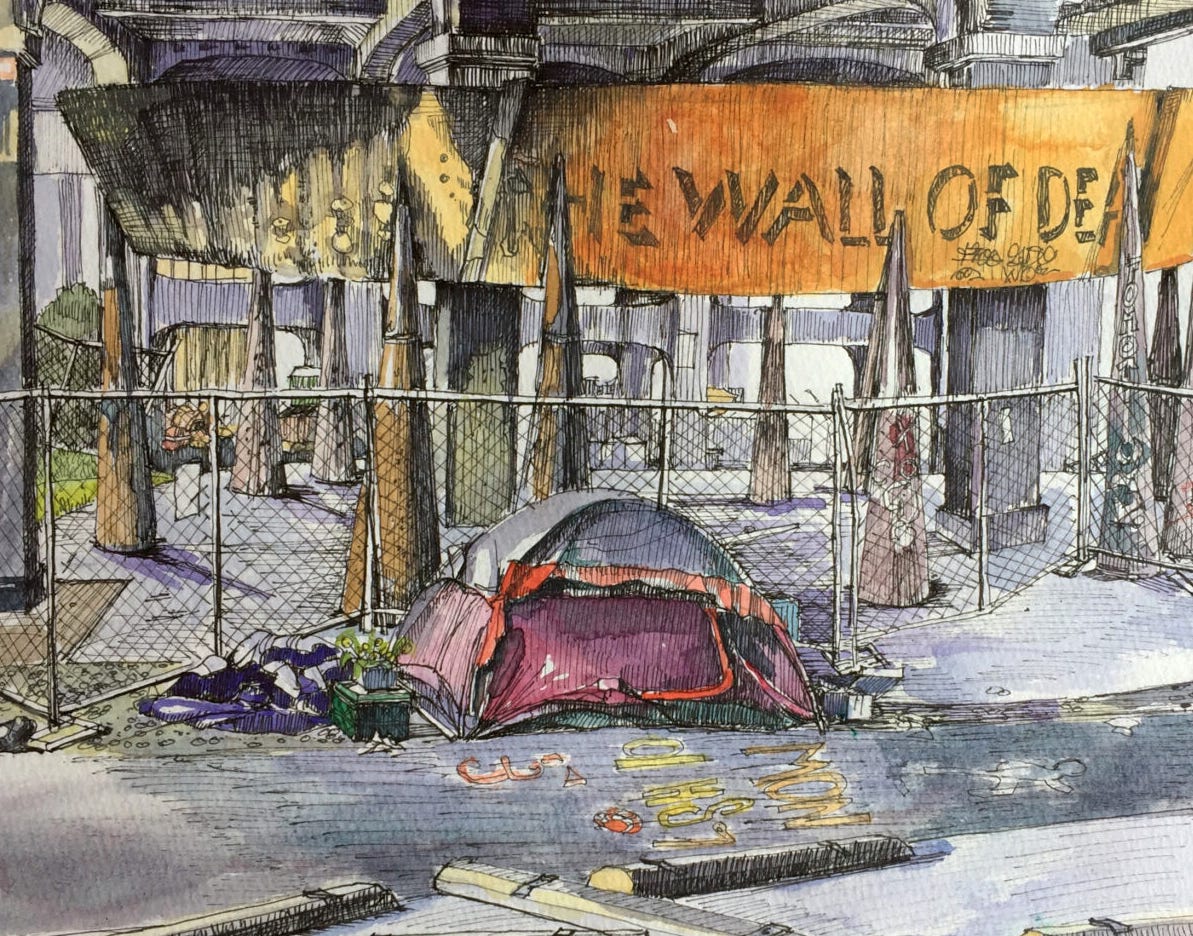
I had the opportunity to talk to artist and educator Daniel Winterbottom about our interest in drawing the blight of homelessness and the unhoused in our various communities. Here is that conversation:
BR: Like me you’ve sketched at homeless encampments in areas where you live. What motivated you to sketch at these places?
DW: Great question. I guess I’ve always been attracted to the liminal spaces that exist within our urban environments, alleys, industrial spaces and landscapes, but the primary impulse was being trapped inside during COVID. I, like many others, began taking walks around my community and became astonished at how much my once familiar landscape had changed. Seemingly overnight blue tarps and RV’s became the dominant elements defining the neighborhood. They were not just situated under overpasses, but in parks, alleys, and along the streets and sidewalks, and became interested in them as I saw both tragedy and beauty. Beauty may sound strange, but the dominant blue tarps hung as the drapery rendered in a Greek sculpture, and many camps were fascinating in the level of creativity expressed by the occupants in the handmade made shrines, sculpture, and shelters. It’s tragic in the lack of care, empathy and resource allocations to address the inequities in the growing discrepancy between the have and the have nots. I have always felt I’m not more than a medical calamity away from similar destitution, and it is only my marginal safety net of employment and insurance that protects me. The reality is that so many others don’t have that, nor a caring family, or a mental health condition that remains untreated. I view urban sketching as both art and reportage and the houseless crisis has been, and still is one, of the contentious issues in urban and rural communities. As a reportage sketcher I view our role as not just documenting beauty, travel scenes and sunsets, but also as advocates who shed light on the maybe less visible and unjust conditions that exist within our communities.
BR: I think it’s important for artists to draw the unseen, even if it’s not pretty, and be more of a visual journalist. We can use our platforms and other media to publicize that. There have been artists throughout history who have ‘taken up the mantle,’ given their (uniquely creative) skills.
DW: No question, and this is in keeping with so many who came before us. Vincent Van Gogh and his poignant sketches of the potato eaters; the sketchers of the 1930’s, like architect Victor Steinbruck who documented the dust bowl ‘Hoovervilles’ or Edgar Ainsworth who traveled with British forces, as they liberated Bergen-Belsen Concentration Camp in 1945. The question always remains, in the back of my mind: am I making this too pretty, too palatable, and therefore minimizing the injustice that motivates our work?


BR: I think it’s impossible not to imbue some aesthetics into a drawing. We see the truth subjectively. We have to make choices, like how to compose a drawing so it communicates effectively. I wrote about an artist named Chittaprosad Bhattacharya, who sketched some challenging scenes of suffering during the Bengal Famine of 1943.
‘I have always felt I’m not more than a medical calamity away from similar destitution, and it is only my marginal safety net of employment and insurance that protects me.’
- Daniel Winterbottom
BR: What challenges did you face while drawing at homeless encampments?
DW: Not many. There was curiosity and at times suspicion, but once I had a conversation with the occupants most residents welcomed me. Many wanted to talk and explain their situations and a surprising number had or were drawing and painting themselves. On a few occasions I exchanged art with residents. The most difficult times were when I realized how serious mental illness was for many of those living in the encampments. I was once sketching a site where a woman had created this elaborate rambling tree house construction under Highway I-5 with an enormous American flag covering one side of the structure. It must have been from a stadium as it was so big. As I sat and started the sketch, she started howling in a tone that was almost animal like. It wasn’t clear to me what was being said but the level of agitation I was causing was clear and I left and never finished the sketch. Now that you mention it, that was the most upsetting occurrence, but luckily a rare one.


BR: I think you made the respectful choice in leaving. That reminds me of the time I drew a couple of folks singing away to a Karaoke machine in a tent at an encampment under Highway 101. They didn’t seem to mind. I live in Marin County, north of San Francisco, one of the wealthiest communities in America. I’ve drawn at three encampments near me. I was left alone for the most part, but a few times I was accompanied by folks from The Spahr Center who did outreach, like needle exchange and HIV /AIDS testing for the LGBTQ+ community. They educated me. BTW, they recently closed down their operations due to a lack of funding.

BR: What was important for you to show? What did you turn away from? Did you consider any privacy issues if you chose to draw people?
DW: My answer to the last question pertains as well to this one. My rule of thumb is to ask any residents who are around if it is okay to sketch the scene and if they have any objections I leave. The most common response, and frankly a rare one was, am I drawing them? I rarely draw the residents of the camps for this very reason, that many residents are either uncomfortable being documented in the context of being houseless or were wanted by the police and not comfortable with me documenting their image. None, other than the women I described asked me not to sketch their tent or RV. I try to be authentic to the scene, as a reporter documenting a point in time, so my sketches tend to have a high level of detail, one could say accuracy to both document and also to pay homage to the resilience, creativity, and survival skills that are displayed. The reality is houselessness is hard, getting the basics, electricity, water, going to the bathroom, health and sanitation, these are not easy. I found early in the process before the clearings began in earnest, strong communities were formed. They were supportive communities of care that I think few who pass by would be aware of. As far as turning away, on occasion I would wander into an encampment and some of the residents are using drugs and very high. I do not sketch those activities for what I think is obvious reasons, they most likely wouldn’t want me to and to respect that a percentage of the residents are active addicts and though often shamed by their actions, they can’t control them. It felt that I would be taking advantage of their weaknesses that seemed wrong and for what purpose?

BR: Typically I’ll just start talking to people, then open my sketchbook and draw. I won’t ask first. If they ask me why I’m drawing I’ll say it’s a personal project. I think they appreciate that I’m showing an interest. I was at a camp in Novato, where I heard reports of some violent activity. I needed to be especially vigilant. I drew this vet, who gave me his name (pseudonym) as ‘Leprechaun’. He had a scary pit bull named ‘Brutus’. It was evident Leprechaun was suffering from some sort of PTSD. When a fight broke out in the tent behind him. I high tailed it out of there.
BR: Can you share an anecdote or other experience you had drawing in these environments?
DW: I was on a field trip in Portland, Oregon to document the encampments there. I was sketching a camp above an overpass when a fellow came over to me and we started chatting. He said his name was ‘Peace’. He explained his long journey. He was originally from Brazil via New York City and asked to look through my sketchbook. Afterwards he said he was also an artist and had been creating art for many years. He asked me to wait, then left. He came back a short while later and handed me one of his sketches in the form of tattoo art. He asked if we could exchange drawings to which I agreed. After completing the sketch, I entered the tent encampment, and it was clear that all those there were quite high. They mentioned that Peace was away, and I explained I was dropping off my sketch of him. I do hope he got it since I certainly cherish the one he gave me!
BR: What are the current strategies that Seattle has to address the unhoused?
DW: Wow, that’s a great question and one that is complicated and evolving. There are many strategies that are being employed in Seattle, some temporary and others more permanent. As an architect I’m particularly impressed by the tiny house project that has been growing and is building on what was done during COVID which was mobile tent cities that were installed for a set period in a donated site and came with support services, food, clothing, and sanitation. Today the tiny homes have supplemented the tents for the most part and they are also located on donated sites, therefore temporal. The city is also purchasing motel sites and older apartment buildings for both permanent and transitional housing, though it’s clearly not enough given the demand. There are also city support services that meet with houseless communities prior to their eviction from public land, but the access to their basic needs is done mainly by volunteers that visit the encampments and provide necessities, and references those who need social services, medical treatments, and detox programs. Seattle has had many social services and it’s not uncommon that people from other parts of the country will come to Seattle for those reasons.
BR: It’s true that every city in America has a homeless population. Each new city administration seems to have a strategy on managing this population. San Francisco’s new Mayor Dan Lurie has a plan called HSH (Homelessness Supportive Housing) to end homelessness by 2028. He wants to expand housing, shelters and prevention programs. They’ve also been clearing people out of a few areas of the city, like the Tenderloin, and taking them to the so-called containment zones. California's new Encampment Resolution seeks to support localities to move unsheltered individuals to stable housing rather than displacing them through sweeps. It's been controversial from the start.

BR: Have you seen mental health and substance abuse problems in the encampments?
DW: I did mention this earlier, but the fentanyl and methamphetamine epidemic has had a direct impact on the unhoused population in Seattle. Certainly, many of those in the camps have comorbidities, addiction and one or more mental health disorders. Others have fled domestic violence, been evicted due to unemployment especially during COVID, fled families due to their sexual preferences, or been released from psychiatric hospitals or incarceration. Of course, just being unhoused would in my mind cause depression, anxiety and potentially trigger existing conditions that may have been manageable prior to being unhoused. Once unhoused many lose the ability to receive treatments and medications for mental health problems thus exacerbating the situation.
‘My intent for sketching these scenes is to increase awareness around the issue and hopefully galvanize increased understanding, empathy, which would result in more services.’
- Daniel Winterbottom
BR: Do you think our drawings could make a difference?
DW: Hah, that’s the million-dollar question isn’t it. My intent for sketching these scenes is to increase awareness around the issue and hopefully galvanize increased understanding, empathy, that would result in more services. When I post my sketches on Instagram, I’ll write what I have witnessed, experienced and I often express my feelings about the situation. At times I confront those who may be seeing the post about the moralities and ethics of ignoring a problem that we witness daily. I do see sketching as a form of both reportage and advocacy. For me spending time with unhoused people has been enlightening and enriching. Hearing the stories and witnessing the struggles of the unhoused, and placing myself in its proximity has given me a more realistic and nuanced perspective of the issue. I also found that simply showing up, either to sketch as we do, or to check in and offer a sandwich or toothbrush, does, albeit briefly, matter to those who are unhoused as it means someone cares, someone is interested, someone will look and not turn their gaze away.
BR: I sometimes come away from drawing at encampments feeling depressed at the enormity of the problem, yet appreciative that I have a roof over my head. What’s the hardest aspect of this type of sketching for you?
DW: I can relate. I find this form of sketching emotionally draining at times. When you go to a scene and the tent or truck that only yesterday had been a domicile, is now a blackened wreck, and the inhabitant may have lost their life in the fire it’s wrenching. Even if they did not sustain injuries or loss of life, the loss of the few belongings they possessed I find very sad. These people, itinerant, unstable and without a place to store their possessions have lost most of their personal histories, and this may be compounded with an actual estrangement with their family. This, especially when you meet someone older in life seems so unfair, unfair that their final years should be alone and so hard.
‘We do this because we see sketching as a potent vehicle for socially conscious work, a medium to tell the stories of the unacknowledged, and to try to illuminate the great need for care, empathy and resources.’
- Daniel Winterbottom
BR: What has the response been to your work from the public in posts, exhibitions, publications?
DW: For the posts, I do find that a sunny sketch in Venice will garner more likes and comments than a homeless encampment. That said, many of those exposed to the work admire the effort to bring the issue forward within the sketching community. I have had a few exhibitions, and the work has been very well received, both the sketches and the narratives that accompany the images. I guess the reality is that we don’t do this for the likes, or the accolades if there are any. We do this because we see sketching as a potent vehicle for socially conscious work, a medium to tell the stories of the unacknowledged, and to try to illuminate the great need for care, empathy and resources. I’m so glad we have met and that you are continuing the pursuit of these aspirational and laudable goals!
BR: Thanks, Daniel. Let’s keep up the important work.
About Daniel Winterbottom:
Daniel Winterbottom, FASLA is a professor of landscape architecture at the University of Washington in Seattle. He has created a range of art including painting, ceramic, sculpture, and drawing. His love of urban wandering led to a spontaneous passion for urban sketching and reportage. He was awarded an Urban Sketchers Reportage Grant for his project: The Shifting Landscapes of Despair, Hope, Survival and Persistence. His Instagram is @koolbreeeeeeze
More to Know:
Sketching the Housing Crisis, Daniel Winterbottom’s pandemic sketchbook has become a prompt to design activism.
Kevin Fagan’s The Lost and Found: A True Story of Homelessness, Found Family, and Second Chances! provides a compelling, firsthand narrative.
See more of my drawings of the houseless and their encampments at RussellReportage.com.


The sketches are indelible works of reportage and the conversation is illuminating in so many ways.